
When Christopher Feran forecast 50% growth for his roastery, he did something that reads backward on paper: he sold his 8 kg production roaster and replaced it with one less than half the size, a 3 kg ROEST P3000. His hourly output didn’t drop.
That’s the counterintuitive part, and it’s the whole point. Batch size is the number everyone reads off the spec sheet. Throughput, how fast you roast and reset, is the one that fills your bags.
Christopher has roasted coffee for more than fifteen years, working as a consultant, green buyer, and sourcing from producers across Africa and Latin America. In 2024, he founded Aviary, a small roastery in Cleveland, Ohio, built on a simple idea: handle production himself, never compromise on quality. He’s also a long-time ROEST roaster, having run our sample roasters in his lab for three years. For Aviary’s first two production years, he roasted on an 8 kg electric roaster from another brand. Entering year three, with volume forecast to grow by half, he moved everything onto a single P3000.
“This machine’s capacity is three kilos. The old one was eight, but because of the efficiency of heat transfer on this machine, I actually didn’t lose any productivity.”
Here’s how a smaller drum moves the same coffee, and why the number on the spec sheet isn’t the one that matters.
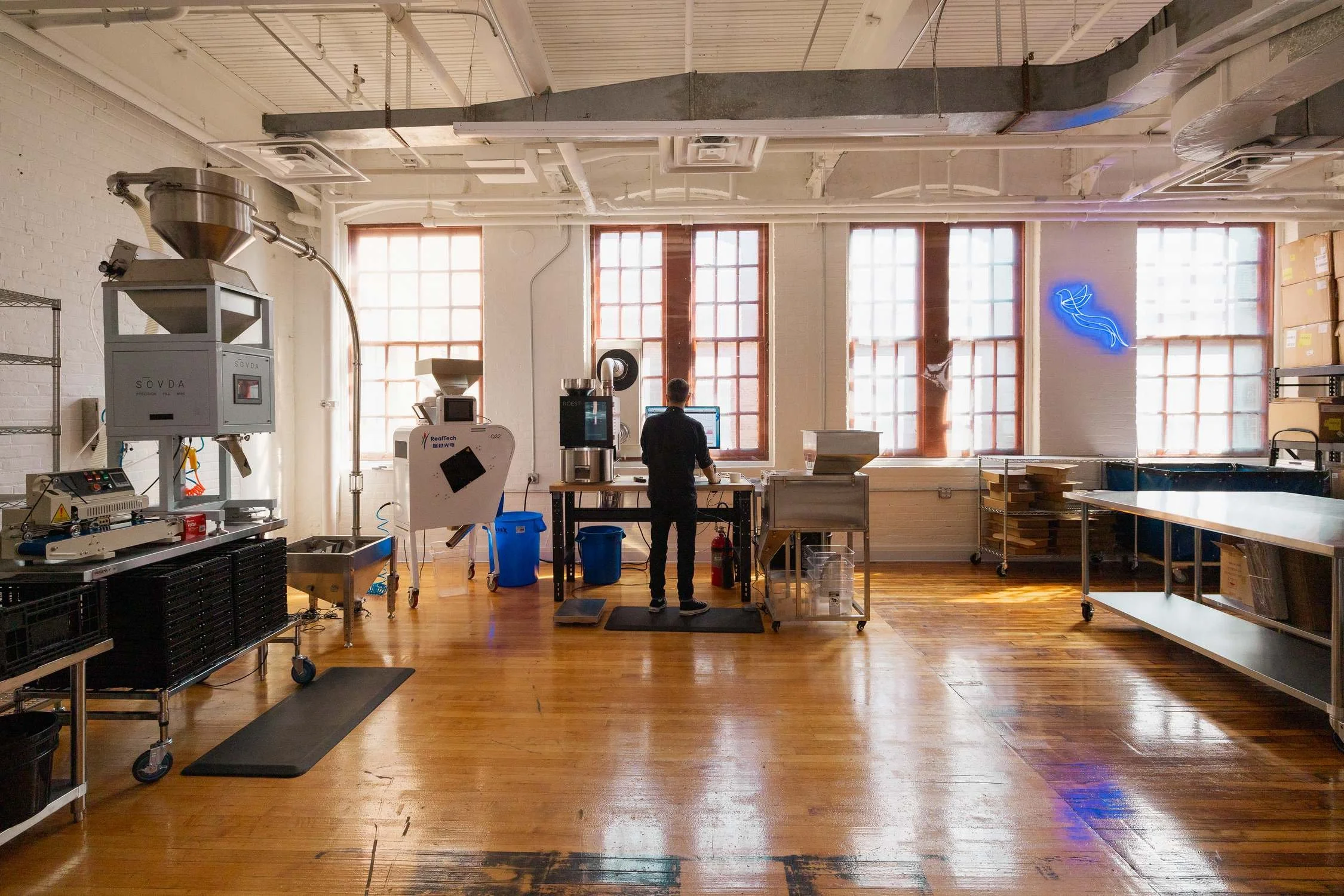
Aviary’s roastery in Cleveland, Ohio, where Christopher runs production on his own.
Credit: Grace McConnell
Is a 3 kg roaster enough for production?
It’s the first thing most roasters think when they see the P3000, and it’s a fair question. But it measures the wrong thing.
Batch size is a snapshot. Throughput is the whole picture: how long a batch takes, plus how quickly the machine recovers before the next one. Christopher’s old roaster was rated at 8 kg, but in practice, he was able to run it at 6 kg. Roasting it to its full rating meant more aggressive heat, longer roast times, and longer between-batch recovery. Those 6 kg batches took about nine minutes each, with another five to six minutes to reset, or roughly four batches an hour. The P3000 turns around a full 3 kg batch in about six minutes, with roughly one minute of recovery, enough for seven to eight batches an hour.
Run the two side by side, and the smaller machine lands within a few hundred grams of the bigger one, hour for hour.
“With the P3000 I’m really roasting between 23 and 25 kilos an hour.”
How much can a 3 kg roaster actually produce?
The efficiency comes from how the P3000 applies heat. It roasts in counterflow: rotating paddles push the coffee pile into the incoming inlet air rather than away from it, so very little air slips past the beans on its way to exhaust. That’s what lets the machine transfer heat so efficiently that it can roast a full batch quickly, at lower air temperatures, and reset in about a minute.
What that adds up to in a real production day is the number worth remembering: in just under five hours, working alone, Christopher roasted, sorted, bagged, sealed, and boxed what started as 99 kg of green coffee. He started at 12:13 pm, and his last roast dropped at 4:51 pm; by the time the machine had cooled, every batch was packed. By his own math, that’s just 400 grams an hour short of what his much larger 8 kg machine managed at its best, from batches less than half the size.
The switch also cut Christopher’s electrical overhead. His previous setup needed a $4,500 step-up transformer and pulled up to 75 kW at peak. His P3000 runs off a standard 240v panel and draws just 10.24 kW at peak, with no transformer required.
A production workflow built for one person

Christopher handles roasting, sourcing and packing himself.
Credit: Grace McConnell
Christopher runs Aviary solo, handling roasting, sourcing, and packing. So the P3000’s automation had to earn its place in the roastery, not just on a spec sheet.
“The automation is so good that I’m able to start the batch, walk away, bag the previous one while it’s still going, and it never misses a beat. It allows me to grow without having to hire.”
When he needs more capacity, the plan is simply a second P3000: same profiles, same results, plus built-in redundancy if one ever needs service. Start with one, add units as you grow.
It helped that he wasn’t starting from scratch on the software, either. Because he already ran our sample roasters, the P3000 functions on the same ROEST Connect platform he was already using. Live roast logging, roast analysis, and quality control all sit in the same place he already works.
Consistency you can measure
None of that speed would count for anything if the roasts weren’t repeatable. This is where the data gets interesting. Across 146 batches on his old 8 kg roaster, Christopher’s roast-loss standard deviation averaged 0.23%, or about ±13.8 g in a 6 kg batch. Across 157 batches on the ROEST P3000, it dropped to 0.04%, or roughly ±1.2 g in a 3 kg batch. That level of precision, he says, has held steady across hundreds of roasts.
“The P3000 offers the consistency of a much larger machine but in a small-batch format.”
For a solo roaster, that repeatability is the business. Every bag has to carry the same promise, day after day.
“With the P3000, I am a single person operating this business, and I just trust that it works.”
What it means in the cup
Consistency on paper is one thing. What matters to the people drinking Aviary’s coffee is what ends up in the bag.
Because the P3000 roasts in counterflow at lower temperatures, Christopher gets cleaner cups and a long shelf life. That shelf life counts for a lot in his case, because Aviary ships to 35 countries, with transit times that can run four to six weeks. Set against a traditional roaster, freshness on arrival is the difference he notices most:
“If I had roasted on a traditional roaster, it’d be tasting dead. On this machine, it’s vibrant, it tastes fresh.”
Separately, he has compared the P3000 directly against the 8 kg electric roaster he switched from. When he re-roasted every coffee from Aviary’s 2025 season on the P3000, he preferred each one to its original release, finding them more vibrant, aromatic, sweet, and dynamic, with no noticeable roastiness.
Reliability and support
A newer production machine on the market invites a fair question about reliability. Christopher’s P3000 was among the first handful installed in the US, and the feedback he shared after his early roasts fed straight into how we hardened components on later units. He’d already trusted our roasters in his lab for three years before that. We back the machine with spare parts, detailed repair and maintenance guides, and a growing global network of service technicians. Christopher’s confident enough in the platform that he’s planning to add a second P3000, as much for redundancy as for capacity.
Advice for choosing your next production roaster
Christopher is candid that plenty of roasters get into the craft chasing flavor and personal style alone. Running a business, he says, asks you to weigh a few more things: reliability and repairability, workflow and management, and above all, consistency, since a roastery’s reputation rests on producing the same style every single time.
“You really need to consider the right piece of equipment for your business, because it is a business. And the P3000 is the solution for that for me.”
Interested in the P3000?
The P3000 is our automated production roaster with up to 25 kg/h throughput, built to roast specialty coffee you’re proud of, from your first batch to 500+ kg per week.
You can read Christopher’s full write-up on the switch on his own blog, and find out more about his roastery at aviary.coffee.
